

Infrastructure Risk Profiles in Today’s Economic Climate
Clearly defining an investment strategy in infrastructure has never been more important.
The significant increase in capital allocated to infrastructure strategies over the last decade suggests the asset class has continued to develop into an asset mix staple.
After a stronger fundraising environment in 2025, infrastructure entered 2026 with substantial capital still available for deployment, though transaction activity and exit timelines remain uneven.1
Now, with continued public market uncertainty and higher sensitivity to rates, policy, and power demand, there is renewed focus on the opportunities provided by infrastructure assets.
We believe that in times of public market volatility, stability matters. The long-term horizon of private market investments should enable managers to maintain focus on delivering value through economic cycles.
However, pressure to deploy capital may lead to the expansion of infrastructure definitions, along with varying interpretations of the term “infrastructure investing.”
Expansion of the Investable Infrastructure Universe
While manager-driven expansion of infrastructure classifications may support the deployment of capital, we are mindful that it may also inadvertently push investors into higher levels of risk.
At this point, has the phrase “higher target returns” actually become a euphemism for greater risk? Does high growth actually suggest underdeveloped?
Recognizing that various infrastructure risk profiles may have a place in a well-diversified allocation, consolidating the wide array of today’s asset opportunities into only “Core” or “Core Plus” definitions seems to have become less prudent, and may obscure true underlying risk exposure.
In our view, defining returns without regard to risk may become less a statement of investment philosophy and more an exercise in fund marketing.
Manager-driven expansion of infrastructure classifications may push investors into higher levels of risk.
“Nowadays, it feels like everything can be infrastructure if you try hard enough – from helicopters to laundromats.”2
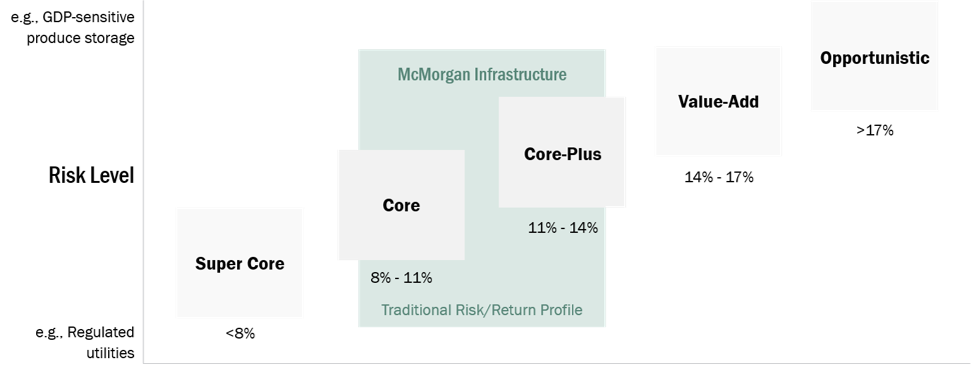
Expected Return3
Our Infrastructure Strategy
McMorgan has long targeted stability, income, and diversification within the infrastructure asset class. That pursuit remains grounded in the classical definition of infrastructure: operationally mature assets that provide essential services to communities in highly developed markets.
Rate regulation, long-term contracts, and reputable counterparties can contribute to asset stability and relatively predictable return profiles. When diversified across geography and sector, these assets can form a portfolio designed to add stability and diversification, with less dependence on public market sentiment or short-term economic trends.
Given this philosophy, the current environment has not changed our infrastructure strategy. We continue to evaluate assets based on the durability of cash flows, downside protections, regulatory and contractual frameworks, and the role each investment is expected to play in a total portfolio.
The Road Ahead
Public-market uncertainty, interest-rate sensitivity, trade-policy risk, geopolitical uncertainty, AI-driven power demand, and grid constraints are likely to keep infrastructure in focus through the end of 2026.
Fundraising improved in 2025, but deal activity remained softer, and abundant dry powder continues to place pressure on managers to deploy capital selectively.4
Those same forces may also encourage investors to move up the risk/return spectrum, particularly into core-plus, value-add, digital infrastructure, and energy-transition strategies. That shift requires discipline. Value-add and opportunistic strategies may contain precisely the GDP sensitivity, merchant exposure, development risk, or valuation risk that some investors are seeking to avoid.
Ultimately, infrastructure allocations should be built around function. A diversified allocation composed primarily of genuine Core and Core Plus exposure, with selective higher-return strategies sized according to their actual risk profile, should be better positioned to weather economic uncertainty and generate positive long-term outcomes.